Hours, prices and access verified by the Whitehaven Beach Tours team — last checked 2026-09-21.
The best time to visit Whitehaven Beach is the dry months, August to
October, when the rain almost stops and the sky is clearest. Whales pass from May to
September. Stingers are in the water all year, so you pack a stinger suit whatever the
month. Book your Whitehaven Beach guided tours with the season in mind.
Dry months against wet months
The Whitsundays have one wet season and one dry one, and the difference is large. At
Hamilton Island Airport, the Bureau of Meteorology's nearest island station, January
brings 297.6 mm of rain and September 25.1 mm. That is about twelve times as much.
Months
Rain (Hamilton Island Airport)
3pm wind, average
What changes for you
December–March
975 mm on about 49 days
24 km/h
The wet months: the most rain, the fewest clear days and the hottest air
April–May
251 mm on about 23 days
26 km/h
Rain falling away, the windiest 3pm average; whales from May
June–August
135 mm on about 16 days
23 km/h
Dry and mild, highs of 21–23 °C; whale calving season
September–November
126 mm on about 12 days
23 km/h
The driest and clearest months; warming again by November
Rain rarely stops a boat, but it changes the day. The sand is at its whitest in
sunshine, and the Hill Inlet view is at its clearest under a blue sky. September has 14.1
clear days on average, and February has 4.5. Month-by-month figures are on
the weather page.
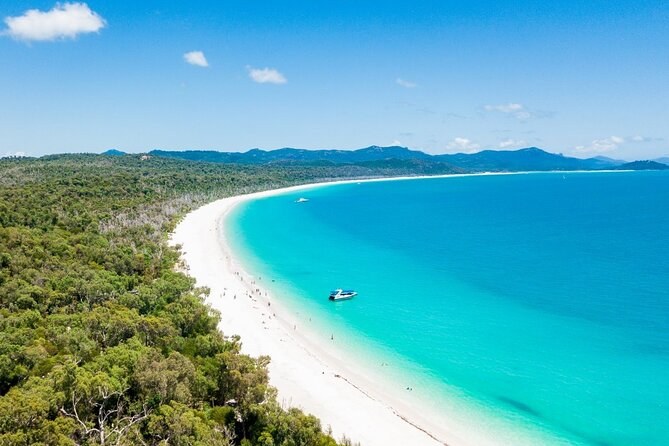
The long white curve of Whitehaven Beach seen from above the forest, one boat anchored in the shallows
Whales, May to September
Which whales:
Humpback whales, migrating up the coast
When:
From May to September
Why here:
The Whitsundays are an important calving ground, according to Queensland Parks and Wildlife Service
How you see them:
From the deck on the way out. None of these tours is sold as a whale-watching trip, so a sighting is a bonus
Winter is the whale season and the dry season at once. A trip in July or August gives
you mild days, highs near 22 °C, and a chance of whales on the crossing.
Stingers are in the water all year
There is no safe month to swim without a suit.
Queensland Parks and Wildlife Service says dangerous marine stingers, sharks and
crocodiles can be in the sea at all times of the year. Irukandji, the small stingers, are
among them. Wear a full-body stinger suit whenever you swim or snorkel, and read
what to expect in the water before you go.
You will see "stinger season" on some tours. Whitehaven Xpress, for example, lists
stinger suits "in stinger season". The park itself names no season, so ask for a suit in
any month. Most snorkelling fares include one.
Tides decide Hill Inlet
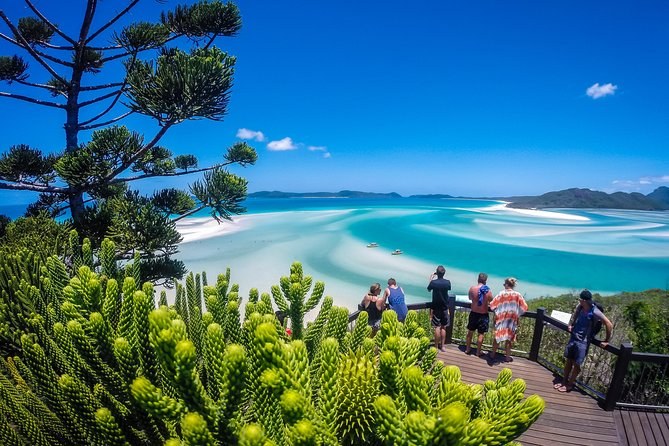
The famous swirl of white sand at Hill Inlet is made by the tide. Queensland Parks and
Wildlife Service describes shapes of blue water and white silica "created by the moving
tides", so the view changes through the day.
The tide also decides access. Boats reach Tongue Bay, where the lookout track starts,
from mid to high tide. That is why Camira's walk is "tidal dependent", and why your
operator fixes the order of the day on the morning.
Morning or afternoon
Most full-day boats leave between 7:30am and 9am and return in the late afternoon.
You get no choice of time, only of day. The half-day catamaran is the exception: it runs
a morning and an afternoon departure, with up to two hours on the southern end.
Choose the afternoon boat if you arrive in Airlie Beach that morning. Choose the
morning one if you want the rest of the day free. Neither visits Hill Inlet.
Know your month?
Compare the tours by how long they give you on the sand, and whether they walk to the Hill Inlet lookout.
The wind blows in every month. At the Bureau's Hamilton Island station, the average
3pm wind runs from 22.4 km/h in July to 26.5 km/h in March and April. The difference
between seasons is small, so the day's forecast matters more than the month.
A windy day makes a raft ride wetter and a sailing day faster. If you get seasick,
choose a large catamaran and sit low and in the middle.
Public holidays and the surcharge
Ocean Rafting adds a charge on Queensland public
holidays. It is $20 per adult, $10 per child and $50 per family, paid at check-in.
Other operators do not list one.
Book early for public holidays and the busy weeks round them, when a full boat day
can sell out.
Questions about timing
What is the best month to visit Whitehaven Beach?
September, on the Bureau of Meteorology's figures. It is the driest month at Hamilton Island Airport, with 25.1 mm of rain, and has the most clear days. August and October are close behind.
When is the wet season in the Whitsundays?
From about December to March. January is the wettest month, with 297.6 mm of rain on about 13 days at Hamilton Island Airport.
When is stinger season at Whitehaven Beach?
Queensland Parks and Wildlife Service gives no season. It says dangerous marine stingers can be in the sea at all times of the year, so wear a stinger suit whenever you swim.
When can you see whales?
From May to September, when the Whitsundays are a calving ground for humpback whales. Several reviewers saw them from the boat on the way out.
What is the best time of day for Hill Inlet?
The tide matters more than the clock. Boats reach Tongue Bay, where the lookout track starts, from mid to high tide, and the tide shapes the swirl of sand below. Operators time the day round it.
Where these facts come from
Rain, temperature, clear days and wind are the Bureau of Meteorology's climate
statistics for Hamilton Island Airport (033106, 2002–2026) and Hamilton Island
(033255, 1985–2002). Whales, stingers and tides are Queensland Parks and Wildlife
Service's, all checked 21 September 2026. Departure times and the surcharge are the operators' own.
Seven hours on an open ocean raft: a reef snorkel in a sunsuit or wetsuit, the guided lookout walk, lunch on the sand and about two hours on the beach. Not recommended in pregnancy or with a bad back.
Eight hours by speedboat, with about three hours on the beach and a barbecue cooked on the sand: steak, sausage or burger. The lookout walk above the inlet is part of the day, and hotel transfers are included.
A morning or afternoon catamaran of just over six hours, with up to two hours at the southern end of the beach and a stinger suit. No lookout walk, and no refund if you cancel.